


Page 8 - ICJ Feb Openaccess 2026
P. 8
TECHNICAL PAPER


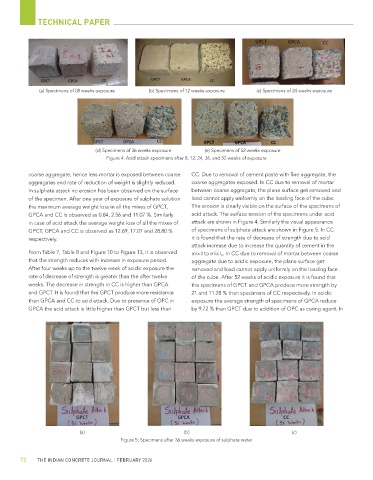
              (a) Specimens of 08 weeks exposure   (b) Specimens of 12 weeks exposure   (c) Specimens of 24 weeks exposure


                                 (d) Specimens of 36 weeks exposure   (e) Specimens of 52 weeks exposure
                                     Figure 4: Acid attack specimens after 8, 12, 24, 36, and 52 weeks of exposure

           coarse aggregate, hence less mortar is exposed between coarse   CC. Due to removal of cement paste with fine aggregate, the
           aggregates and rate of reduction of weight is slightly reduced.   coarse aggregates exposed. In CC due to removal of mortar
           In sulphate attack no erosion has been observed on the surface   between coarse aggregate, the plane surface get removed and
           of the specimen. After one year of exposure of sulphate solution   load cannot apply uniformly on the loading face of the cube.
           the maximum average weight loss in all the mixes of GPCT,   The erosion is clearly visible on the surface of the specimens of
           GPCA and CC is observed as 0.84, 2.56 and 11.07 %. Similarly   acid attack. The surface erosion of the specimens under acid
           in case of acid attack the average weight loss of all the mixes of   attack are shown in Figure 4. Similarly the visual appearance
           GPCT, GPCA and CC is observed as 12.69, 17.07 and 28.80 %   of specimens of sulphate attack are shown in Figure 5. In CC
           respectively.                                          it is found that the rate of decrease of strength due to acid
                                                                  attack increase due to increase the quantity of cement in the
           From Table 7, Table 8 and Figure 10 to Figure 13, it is observed   mix I to mix L. In CC due to removal of mortar between coarse
           that the strength reduces with increase in exposure period.   aggregate due to acidic exposure, the plane surface get
           After four weeks up to the twelve week of acidic exposure the   removed and load cannot apply uniformly on the loading face
           rate of decrease of strength is greater than the after twelve   of the cube. After 52 weeks of acidic exposure it is found that
           weeks. The decrease in strength in CC is higher than GPCA   the specimens of GPCT and GPCA produce more strength by
           and GPCT. It is found that the GPCT produce more resistance   21 and 11.28 % than specimens of CC respectively. In acidic
           than GPCA and CC to acid attack. Due to presence of OPC in   exposure the average strength of specimens of GPCA reduce
           GPCA the acid attack is little higher than GPCT but less than   by 9.72 % than GPCT due to addition of OPC as curing agent. In


                            (a)                                (b)                                 (c)
                                          Figure 5: Specimens after 36 weeks exposure of sulphate water


        72    THE INDIAN CONCRETE JOURNAL | FEBRUARY 2026

