


Page 11 - ICJ Feb Openaccess 2026
P. 11
TECHNICAL PAPER


              40                                                     40
            Compressive strength (MPa)  25                         Compressive Strength (MPa) 45
              35
                                                                     35
              30
                                                                     30
                                                                     25
              20
                                                                     20
              15
                                                                     15
              10
                                                                     10
               5
               0
                0      10      20     30      40     50     60       5 0  0   10      20     30     40      50     60
                           Exposure periods (Weeks)                               Exposure Periods (Weeks)
                       A-C            A-G            A-K                      A-D            A-H            A-L
                       S-C            S-G            S-K                      S-D            S-H            S-L
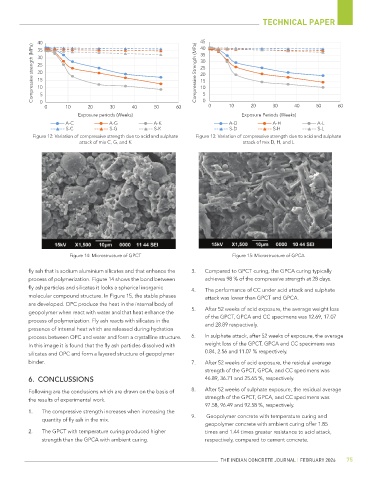
            Figure 12: Variation of compressive strength due to acid and sulphate   Figure 13: Variation of compressive strength due to acid and sulphate
                            attack of mix C, G, and K                              attack of mix D, H, and L


                        Figure 14: Microstructure of GPCT                      Figure 15: Microstructure of GPCA

           fly ash that is sodium aluminium silicates and that enhance the   3.   Compared to GPCT curing, the GPCA curing typically
           process of polymerization. Figure 14 shows the bond between   achieves 98 % of the compressive strength at 28 days.
           fly ash particles and silicates it looks a spherical inorganic   4.   The performance of CC under acid attack and sulphate
           molecular compound structure. In Figure 15, the stable phases   attack was lower than GPCT and GPCA.
           are developed. OPC produce the heat in the internal body of
                                                                  5.   After 52 weeks of acid exposure, the average weight loss
           geopolymer when react with water and that heat enhance the
                                                                      of the GPCT, GPCA and CC specimens was 12.69, 17.07
           process of polymerization. Fly ash reacts with silicates in the
                                                                      and 28.89 respectively.
           presence of internal heat which are released during hydration
           process between OPC and water and form a crystalline structure.   6.   In sulphate attack, after 52 weeks of exposure, the average
           In this image it is found that the fly ash particles dissolved with   weight loss of the GPCT, GPCA and CC specimens was
           silicates and OPC and form a layered structure of geopolymer   0.84, 2.56 and 11.07 % respectively.
           binder.                                                7.   After 52 weeks of acid exposure, the residual average
                                                                      strength of the GPCT, GPCA, and CC specimens was
           6.  CONCLUSSIONS                                           46.89, 36.71 and 25.65 %, respectively.

           Following are the conclusions which are drawn on the basis of   8.   After 52 weeks of sulphate exposure, the residual average
           the results of experimental work.                          strength of the GPCT, GPCA, and CC specimens was
                                                                      97.58, 96.49 and 92.58 %, respectively.
           1.   The compressive strength increases when increasing the
                                                                  9.    Geopolymer concrete with temperature curing and
               quantity of fly ash in the mix.
                                                                      geopolymer concrete with ambient curing offer 1.85
           2.   The GPCT with temperature curing produced higher      times and 1.44 times greater resistance to acid attack,
               strength than the GPCA with ambient curing.            respectively, compared to cement concrete.


                                                                           THE INDIAN CONCRETE JOURNAL | FEBRUARY 2026  75

