


Page 17 - ICJ Feb Openaccess 2026
P. 17
TECHNICAL PAPER


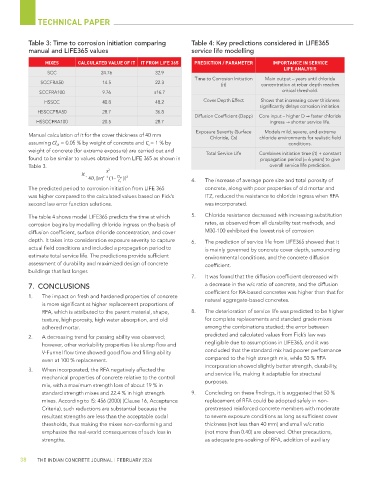
           Table 3: Time to corrosion initiation comparing        Table 4: Key predictions considered in LIFE365
           manual and LIFE365 values                              service life modelling

                MIXES      CALCULATED VALUE OF IT  IT FROM LIFE 365  PREDICTION / PARAMETER  IMPORTANCE IN SERVICE
                                                                                                 LIFE ANALYSIS
                 SCC               24.76             32.9
                                                                   Time to Corrosion Initiation   Main output – years until chloride
               SCCFRA50             14.5             22.3                   (it)         concentration at rebar depth reaches
              SCCFRA100             9.76             s16.7                                      critical threshold.
                HSSCC               40.8             48.2             Cover Depth Effect  Shows that increasing cover thickness
                                                                                         significantly delays corrosion initiation.
              HSSCCFRA50            28.7             36.8
                                                                   Diffusion Coefficient (Dapp)  Core input – higher D → faster chloride
             HSSCCFRA100            20.5             28.7                                   ingress → shorter service life.
                                                                   Exposure Severity (Surface   Models mild, severe, and extreme
           Manual calculation of it for the cover thickness of 40 mm    Chloride, Cs)    chloride environments for realistic field
           assuming Cl th  = 0.05 % by weight of concrete and C s  = 1 % by                       conditions.
           weight of concrete (for extreme exposure) are carried out and   Total Service Life  Combines initiation time (it) + constant
           found to be similar to values obtained from LIFE 365 as shown in              propagation period (≈ 6 years) to give
           Table 3.                                                                         overall service life prediction.
                                     x 2
                             it  =          2
                                    –1
                               4D c  [erf    (1–  Cl th  )]       4.   The increase of average pore size and total porosity of
                                         C s
           The predicted period to corrosion initiation from LIFE 365   concrete, along with poor properties of old mortar and
           was higher compared to the calculated values based on Fick’s   ITZ, reduced the resistance to chloride ingress when RFA
           second law error function solutions.                       was incorporated.

           The table 4 shows model LIFE365 predicts the time at which   5.   Chloride resistance decreased with increasing substitution
           corrosion begins by modelling chloride ingress on the basis of   rates, as observed from all durability test methods, and
           diffusion coefficient, surface chloride concentration, and cover   M30-100 exhibited the lowest risk of corrosion
           depth. It takes into consideration exposure severity to capture   6.   The prediction of service life from LIFE365 showed that it
           actual field conditions and included a propagation period to   is mainly governed by concrete cover depth, surrounding
           estimate total service life. The predictions provide sufficient   environmental conditions, and the concrete diffusion
           assessment of durability and maximized design of concrete   coefficient.
           buildings that last longer.
                                                                  7.   It was found that the diffusion coefficient decreased with
           7.  CONCLUSIONS                                            a decrease in the w/c ratio of concrete, and the diffusion
                                                                      coefficient for RA-based concretes was higher than that for
           1.   The impact on fresh and hardened properties of concrete   natural aggregate-based concretes.
               is more significant at higher replacement proportions of
               RFA, which is attributed to the parent material, shape,   8.   The deterioration of service life was predicted to be higher
               texture, high porosity, high water absorption, and old   for complete replacements and standard grade mixes
               adhered mortar.                                        among the combinations studied; the error between
           2.   A decreasing trend for passing ability was observed;   predicted and calculated values from Fick’s law was
               however, other workability properties like slump flow and   negligible due to assumptions in LIFE365, and it was
               V-Funnel flow time showed good flow and filling ability   concluded that the standard mix had poorer performance
               even at 100 % replacement.                             compared to the high strength mix, while 50 % RFA
                                                                      incorporation showed slightly better strength, durability,
           3.   When incorporated, the RFA negatively affected the    and service life, making it adaptable for structural
               mechanical properties of concrete relative to the control
               mix, with a maximum strength loss of about 19 % in     purposes.
               standard strength mixes and 22.4 % in high strength   9.   Concluding on these findings, it is suggested that 50 %
               mixes. According to IS: 456 (2000) (Clause 16, Acceptance   replacement of RFA could be adopted safely in non-
               Criteria), such reductions are substantial because the   prestressed reinforced concrete members with moderate
               resultant strengths are less than the acceptable codal   to severe exposure conditions as long as sufficient cover
               thresholds, thus making the mixes non-conforming and   thickness (not less than 40 mm) and small w/c ratio
               emphasize the real-world consequences of such loss in   (not more than 0.40) are observed. Other precautions,
               strengths.                                             as adequate pre-soaking of RFA, addition of auxiliary


        38    THE INDIAN CONCRETE JOURNAL | FEBRUARY 2026

