


Page 13 - ICJ Feb Openaccess 2026
P. 13
TECHNICAL PAPER


           The chloride penetration depth when sprayed with AgNO 3  after
           performing split tension for the cubes subject to accelerated
           corrosion process shows higher chloride penetration for
           complete replacement of M-Sand with RFA than the partial
           replacement. This clearly shows that the total porosity of the mix
           increases with RFA and weakens the resistance to penetration
           which is observed in all the results.

           Ultrasonic pulse velocity test results
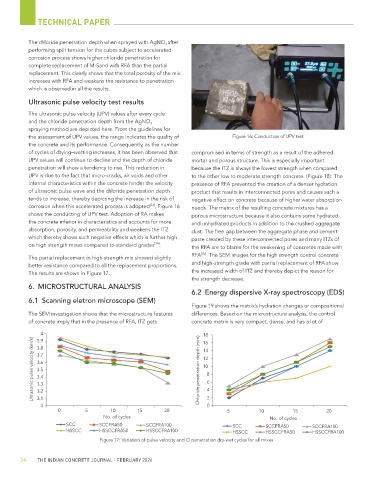
           The ultrasonic pulse velocity (UPV) values after every cycle

           and the chloride penetration depth from the AgNO 3
           spraying method are depicted here. From the guidelines for
           the assessment of UPV values, the range indicates the quality of    Figure 16: Conduction of UPV test
           the concrete and its performance. Consequently, as the number
           of cycles of drying–wetting increases, it has been observed that   compromised in terms of strength as a result of the adhered
           UPV values will continue to decline and the depth of chloride   mortar and porous structure. This is especially important
           penetration will show a tendency to rise. This reduction in   because the ITZ is always the lowest strength when compared
           UPV is due to the fact that micro-cracks, air voids and other   to the other low to moderate strength concrete. (Figure 18). The
           internal characteristics within the concrete hinder the velocity   presence of RFA prevented the creation of a denser hydration
           of ultrasonic pulse wave and the chloride penetration depth   product that results in interconnected pores and causes such a
           tends to increase, thereby depicting the increase in the risk of   negative effect on concrete because of higher water absorption
                                                    [33]
           corrosion when this accelerated process is adopted . Figure 16   needs. The matrix of the resulting concrete mixtures has a
           shows the conducting of UPV test. Adoption of RA makes   porous microstructure because it also contains some hydrated
           the concrete inferior in characteristics and accounts for more   and unhydrated products in addition to the crushed aggregate
           absorption, porosity, and permeability and weakens the ITZ   dust. The free gap between the aggregate phase and cement
           which thereby shows such negative effects which is further high   paste created by these interconnected pores and many ITZs of
                                                     [34]
           on high strength mixes compared to standard grades .   the RFA are to blame for the weakening of concretes made with
                                                                  RFA . The SEM images for the high strength control concrete
                                                                     [35]
           The partial replacement in high strength mix showed slightly
           better resistance compared to all the replacement proportions.   and high-strength grade with partial replacement of RFA show
           The results are shown in Figure 17.                    the increased width of ITZ and thereby depict the reason for
                                                                  the strength decrease.
           6.  MICROSTRUCTURAL ANALYSIS
                                                                  6.2  Energy dispersive X-ray spectroscopy (EDS)
           6.1  Scanning eletron microscope (SEM)
                                                                  Figure 19 shows the matrix’s hydration changes or compositional
           The SEM investigation shows that the microstructure features   differences. Based on the microstructure analysis, the control
           of concrete imply that in the presence of RFA, ITZ gets   concrete matrix is very compact, dense, and has a lot of

               4                                                      16
            Ultrasonic pulse velocity (km/s)  3.7                   Chloride penetration depth (mm) 18 8 6
             3.9
             3.8
                                                                      14
                                                                      12
             3.6
                                                                      10
             3.5
             3.4
             3.3
             3.2
             3.1
               3                                                       4 2 0
                     0        5       10       15       20                    5         10          15         20
                                    No. of cycles                                           No. of cycles
                       SCC         SCCFRA50       SCCFRA100                    SCC         SCCFRA50       SCCFRA100
                       HSSCC       HSSCCFRA50     HSSCCFRA100                  HSSCC       HSSCCFRA50     HSSCCFRA100
                                   Figure 17: Variation of pulse velocity and Cl penetration dry-wet cycles for all mixes


        34    THE INDIAN CONCRETE JOURNAL | FEBRUARY 2026

