


Page 11 - ICJ Feb Openaccess 2026
P. 11
TECHNICAL PAPER


             0.8  0.68 0.61  0.7 0.63  0.69 0.6  0.67 0.59  0.68 0.58  0.7 0.6  6  y = 0.0786x + 0.532
            Tensile strength ratio  0.6  0.44  0.46  0.44  0.53  0.54  0.55  5 4     R² = 0.9932  SCCFRA100  HSSCCFRA50
             0.7
                                                                                                               HSSCC
             0.5
             0.4
             0.3
                                                                                     SCCFRA50
             0.2
                                                                                               SCC
             0.1
              0                                                    Tensile strength, MPa  3 2  SCCFRA100
                        SCCFRA50  SCCFRA100   HSSCCFRA50  HSSCCFRA100  1
                   SCC                  HSSCC


                                     MIX ID                         0  0    10    20     30    40     50    60     70
                7days/28 days   7days/56 days   7days/90 days                      Compressive strength, MPa
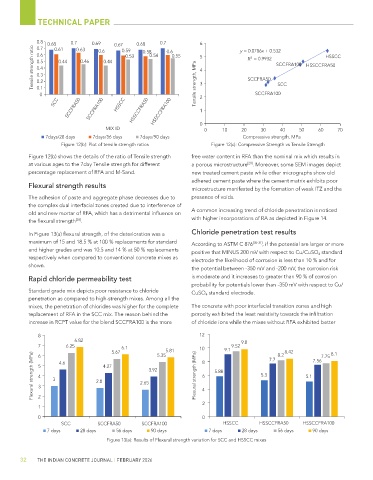
                      Figure 12(b): Plot of tensile strength ratios     Figure 12(c): Compressive Strength vs Tensile Strength
           Figure 12(b) shows the details of the ratio of Tensile strength   free water content in RFA than the nominal mix which results in
           at various ages to the 7day Tensile strength for different   a porous microstructure . Moreover, some SEM images depict
                                                                                     [29]
           percentage replacement of RFA and M-Sand.              new treated cement paste while other micrographs show old
                                                                  adhered cement paste where the cement matrix exhibits poor
           Flexural strength results                              microstructure manifested by the formation of weak ITZ and the

           The adhesion of paste and aggregate phase decreases due to   presence of voids.
           the complex dual interfacial zones created due to interference of
           old and new mortar of RFA, which has a detrimental influence on   A common increasing trend of chloride penetration is noticed
                           [28]
           the flexural strength .                                with higher incorporations of RA as depicted in Figure 14.
           In Figure 13(a) flexural strength, of the deterioration was a   Chloride penetration test results
           maximum of 15 and 18.5 % at 100 % replacements for standard   According to ASTM C 876 [30-31] , if the potential are larger or more
           and higher grades and was 10.5 and 14 % at 50 % replacements   positive that MINUS 200 mV with respect to Cu/CuSO 4  standard
           respectively when compared to conventional concrete mixes as   electrode the likelihood of corrosion is less than 10 % and for
           shown.
                                                                  the potential between -350 mV and -200 mV, the corrosion risk
           Rapid chloride permeability test                       is moderate and it increases to greater than 90 % of corrosion
                                                                  probability for potentials lower than -350 mV with respect to Cu/
           Standard grade mix depicts poor resistance to chloride   CuSO 4  standard electrode.
           penetration as compared to high-strength mixes. Among all the
           mixes, the penetration of chlorides was higher for the complete   The concrete with poor interfacial transition zones and high
           replacement of RFA in the SCC mix. The reason behind the   porosity exhibited the least resistivity towards the infiltration
           increase in RCPT value for the blend SCCFRA100 is the more   of chloride ions while the mixes without RFA exhibited better

              8                                                     12
                          6.82                                                    9.8
              7 6      6.25            5.67  6.1      5.35 5.81     10       9.1 9.52       7.7  8.2 8.42  7.56 7.75  8.1
            Flexural strength (MPa)  5 4 3  3  4.6  2.8 4.27  2.65 3.92  Flexural strength (MPa)  8 6 4  5.88  5.3  5.1


              2
                                                                     2
              1
              0                                                      0
                      SCC         SCCFRA50       SCCFRA100                  HSSCC       HSSCCFRA50     HSSCCFRA100
                 7 days     28 days     56 days     90 days            7 days      28 days     56 days    90 days
                                     Figure 13(a): Results of Flexural strength variation for SCC and HSSCC mixes


        32    THE INDIAN CONCRETE JOURNAL | FEBRUARY 2026

