


Page 7 - ICJ Feb Openaccess 2026
P. 7
TECHNICAL PAPER


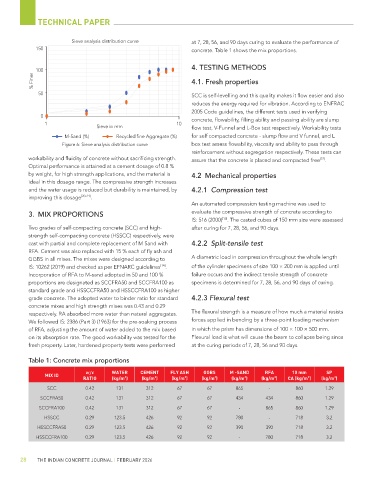
                         Sieve analysis distribution curve        at 7, 28, 56, and 90 days curing to evaluate the performance of
             150                                                  concrete. Table 1 shows the mix proportions.


             100                                                  4. TESTING METHODS
            % Finer                                               4.1. Fresh properties


              50                                                  SCC is self-levelling and this quality makes it flow easier and also
                                                                  reduces the energy required for vibration. According to ENFRAC
                                                                  2005 Code guidelines, the different tests used in verifying
               0                                                  concrete, flowability, filling ability and passing ability are slump
                1                                            10
                                  Sieve in mm                     flow test, V-Funnel and L-Box test respectively. Workability tests
                       M-Sand (%)       Recycled fine Aggregate (%)  for self compacted concrete - slump flow and V funnel, and L
                      Figure 6: Sieve analysis distribution curve  box test assess flowability, viscosity and ability to pass through
                                                                  reinforcement without segregation respectively. These tests can
           workability and fluidity of concrete without sacrificing strength.   assure that the concrete is placed and compacted free .
                                                                                                             [22]
           Optimal performance is attained at a cement dosage of 0.8 %
           by weight, for high strength applications, and the material is   4.2  Mechanical properties
           ideal in this dosage range. The compressive strength increases
           and the water usage is reduced but durability is maintained, by   4.2.1  Compression test
           improving this dosage [20-21] .
                                                                  An automated compression testing machine was used to
                                                                  evaluate the compressive strength of concrete according to
           3.  MIX PROPORTIONS
                                                                  IS: 516 (2000) . The casted cubes of 150 mm size were assessed
                                                                            [15]
           Two grades of self-compacting concrete (SCC) and high-  after curing for 7, 28, 56, and 90 days.
           strength self-compacting concrete (HSSCC) respectively, were
           cast with partial and complete replacement of M Sand with   4.2.2  Split-tensile test
           RFA. Cement was also replaced with 15 % each of fly ash and
           GGBS in all mixes. The mixes were designed according to   A diametric load in compression throughout the whole length
                                                       [14]
           IS: 10262 (2019) and checked as per EFNARC guidelines .   of the cylinder specimens of size 100 × 200 mm is applied until
           Incorporation of RFA to M-sand adopted in 50 and 100 %   failure occurs and the indirect tensile strength of concrete
           proportions are designated as SCCFRA50 and SCCFRA100 as   specimens is determined for 7, 28, 56, and 90 days of curing.
           standard grade and HSSCCFRA50 and HSSCCFRA100 as higher
           grade concrete. The adopted water to binder ratio for standard   4.2.3 Flexural test
           concrete mixes and high strength mixes was 0.43 and 0.29
           respectively. RA absorbed more water than natural aggregates.   The flexural strength is a measure of how much a material resists
           We followed IS: 2386 (Part 3) (1963) for the pre-soaking process   forces applied in bending by a three-point loading mechanism
           of RFA, adjusting the amount of water added to the mix based   in which the prism has dimensions of 100 × 100 × 500 mm.
           on its absorption rate. The good workability was tested for the   Flexural load is what will cause the beam to collapse being since
           fresh property. Later, hardened property tests were performed   at the curing periods of 7, 28, 56 and 90 days.

           Table 1: Concrete mix proportions

                              w/c      WATER    CEMENT     FLY ASH    GGBS     M -SAND    RFA       10 mm      SP
                MIX ID
                                                                         3
                                                               3
                                                                                   3
                                                                                              3
                                                                                                         3
                                                                                                                  3
                                                     3
                                           3
                             RATIO     (kg/m )   (kg/m )   (kg/m )   (kg/m )   (kg/m )   (kg/m )  CA (kg/m )  (kg/m )
                 SCC          0.42      131       312        67        67        865        -        860       1.29
               SCCFRA50       0.42      131       312        67        67        434       434       860       1.29
              SCCFRA100       0.42      131       312        67        67         -        865       860       1.29
                HSSCC         0.29      123.5     426        92        92        780        -        718       3.2
              HSSCCFRA50      0.29      123.5     426        92        92        390       390       718       3.2
             HSSCCFRA100      0.29      123.5     426        92        92         -        780       718       3.2
        28    THE INDIAN CONCRETE JOURNAL | FEBRUARY 2026

