


Page 9 - ICJ Feb Openaccess 2026
P. 9
TECHNICAL PAPER


           M30-0
                                                                                                               M60


           M30-50                                                                                              M60-50


           M30-100                                                                                             M60-100


                          Figure 9: Chloride penetration depth in concrete specimens after 20 cycles of alternate wetting and drying


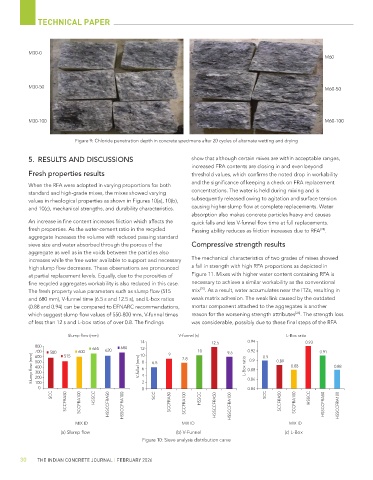
           5.  RESULTS AND DISCUSSIONS                            show that although certain mixes are within acceptable ranges,
                                                                  increased FRA contents are closing in and even beyond
           Fresh properties results                               threshold values, which confirms the noted drop in workability
                                                                  and the significance of keeping a check on FRA replacement
           When the RFA were adopted in varying proportions for both
           standard and high-grade mixes, the mixes showed varying   concentrations. The water is held during mixing and is
           values in rheological properties as shown in Figures 10(a), 10(b),   subsequently released owing to agitation and surface tension
           and 10(c), mechanical strengths, and durability characteristics.  causing higher slump flow at complete replacements. Water
                                                                  absorption also makes concrete particles heavy and causes
           An increase in fine content increases friction which affects the   quick falls and less V-funnel flow time at full replacements.
           fresh properties. As the water-cement ratio in the recycled   Passing ability reduces as friction increases due to RFA .
                                                                                                             [24]
           aggregate increases the volume with reduced passing standard
           sieve size and water absorbed through the porous of the   Compressive strength results
           aggregate as well as in the voids between the particles also
           increases while the free water available to support and necessary   The mechanical characteristics of two grades of mixes showed
           high slump flow decreases. These observations are pronounced   a fall in strength with high RFA proportions as depicted in
           at partial replacement levels. Equally, due to the porosities of   Figure 11. Mixes with higher water content containing RFA is
           fine recycled aggregates workability is also reduced in this case.   necessary to achieve a similar workability as the conventional
                                                                    [25]
           The fresh property value parameters such as slump flow (515   mix . As a result, water accumulates near the ITZs, resulting in
           and 680 mm), V-funnel time (6.5 s and 12.5 s), and L-box ratios   weak matrix adhesion. The weak link caused by the outdated
           (0.88 and 0.94) can be compared to EFNARC recommendations,   mortar component attached to the aggregates is another
                                                                                                     [26]
           which suggest slump flow values of 550-800 mm, V-funnel times   reason for the worsening strength attributes . The strength loss
           of less than 12 s and L-box ratios of over 0.8. The findings   was considerable, possibly due to these final steps of the RFA
                        Slump flow (mm)                      V-funnel (s)                         L-Box ratio
                                                14                      12.5         0.94               0.93
             800                665       680   12
             700  580  515  600     620         10        9   7.8   10        9.6    0.92  0.9               0.91
            Slump flow (mm)  500                V-fullel (mm)  8 6 4  6.5           L-Box ratio  0.88  0.89  0.88  0.88
             600
                                                                                     0.9
             400
             300
             200
             100
              0                                  2 0                                 0.86
                                                                                     0.84
                  SCC            HSSCC               SCC                                   SCC           HSSCC
                       SCCFRA50  SCCFRA100  HSSCCFRA50  HSSCCFRA100  SCCFRA50  SCCFRA100  HSSCC  HSSCCFRA50  HSSCCFRA100  SCCFRA50  SCCFRA100  HSSCCFRA50  HSSCCFRA100


                          MIX ID                              MIX ID                               MIX ID
                     (a) Slump flow                         (b) V-Funnel                         (c) L-Box
                                                 Figure 10: Sieve analysis distribution curve


        30    THE INDIAN CONCRETE JOURNAL | FEBRUARY 2026

