


Page 8 - ICJ Feb Openaccess 2026
P. 8
TECHNICAL PAPER


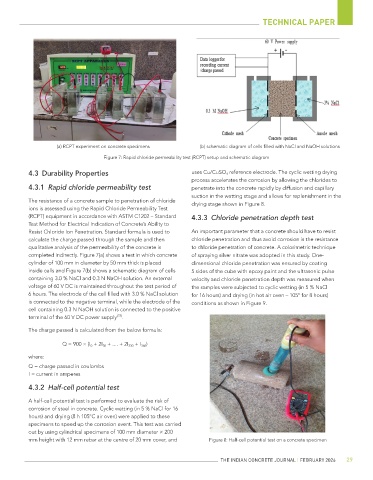
                    (a) RCPT experiment on concrete specimens       (b) schematic diagram of cells filled with NaCl and NaOH solutions
                                    Figure 7: Rapid chloride permeability test (RCPT) setup and schematic diagram


           4.3  Durability Properties                             uses Cu/CuSO 4  reference electrode. The cyclic wetting drying
                                                                  process accelerates the corrosion by allowing the chlorides to
           4.3.1  Rapid chloride permeability test                penetrate into the concrete rapidly by diffusion and capillary

                                                                  suction in the wetting stage and allows for replenishment in the
           The resistance of a concrete sample to penetration of chloride   drying stage shown in Figure 8.
           ions is assessed using the Rapid Chloride Permeability Test
           (RCPT) equipment in accordance with ASTM C1202 – Standard   4.3.3  Chloride penetration depth test
           Test Method for Electrical Indication of Concrete’s Ability to
           Resist Chloride Ion Penetration. Standard formula is used to   An important parameter that a concrete should have to resist
           calculate the charge passed through the sample and then   chloride penetration and thus avoid corrosion is the resistance
           qualitative analysis of the permeability of the concrete is   to chloride penetration of concrete. A colorimetric technique
           completed indirectly. Figure 7(a) shows a test in which concrete   of spraying silver nitrate was adopted in this study. One-
           cylinder of 100 mm in diameter by 50 mm thick is placed   dimensional chloride penetration was ensured by coating
           inside cells and Figure 7(b) shows a schematic diagram of cells   5 sides of the cube with epoxy paint and the ultrasonic pulse
           containing 3.0 % NaCl and 0.3 N NaOH solution. An external   velocity and chloride penetration depth was measured when
           voltage of 60 V DC is maintained throughout the test period of   the samples were subjected to cyclic wetting (in 5 % NaCl
           6 hours. The electrode of the cell filled with 3.0 % NaCl solution   for 16 hours) and drying (in hot air oven – 105° for 8 hours)
           is connected to the negative terminal, while the electrode of the   conditions as shown in Figure 9.
           cell containing 0.3 N NaOH solution is connected to the positive
                                        [23]
           terminal of the 60 V DC power supply .
           The charge passed is calculated from the below formula:

                      Q = 900 × (I 0  + 2I 30  + .... + 2I 330  + I 360 )
           where:
           Q = charge passed in coulombs
           I = current in amperes

           4.3.2  Half-cell potential test

           A half-cell potential test is performed to evaluate the risk of
           corrosion of steel in concrete. Cyclic wetting (in 5 % NaCl for 16
           hours) and drying (8 h 105°C air oven) were applied to these
           specimens to speed up the corrosion event. This test was carried
           out by using cylindrical specimens of 100 mm diameter × 200
           mm height with 12 mm rebar at the centre of 20 mm cover, and   Figure 8: Half-cell potential test on a concrete specimen


                                                                           THE INDIAN CONCRETE JOURNAL | FEBRUARY 2026  29

